Inside the Compost Bin is listed as a resource for several classroom lesson plans and even has a curriculum designed around it! To find out more about these resources and how you can incorporate composting and Inside the Compost Bin into your classroom, check out the following links (please note that I have not personally tested these resources myself in a classroom setting):
You came into our lives when you could fit in the palms of our hands. 15 years is a long time for any dog, and yet, it’s not long enough. But you’re not in pain anymore and yesterday, Heaven got one more good dog. It’s a good trade. We love and miss you Cali, challenging days at work were made shorter because you were by my side. Thank you for everything.
I probably get as excited for Earth Month as much as some people get excited for the holidays. Maybe it’s because at least for one month out of the year when I share my excitement with a stranger about something nature, climate, or sustainability related, it’s usually enthusiastically received and in-theme for April. During Earth Month there is much more sharing of positive news about the planet than any other time of the year, businesses are proudly showing off their sustainable practices, and on Earth Day (April 22), people come together to actively move the needle for a healthier, more beautiful world to live in.
I always hope that all this peak action would extend past the month and into the entirety of the year. It always brings me joy to hear and see sustainability take more prominence in our daily lives. It’s in the laws for how we manage our waste, and in the store aisles we walk through as we’re presented with options to choose products that are more mindfully sourced and produced. It’s in the recycled fabrics of the clothing we wear, in the plots of movies we watch, and in between the pages of the books we read. It’s in the electrified transportation we commute on, and in the food we choose, and don’t choose, to eat. Speaking of electrified, did you know that the theme for this year’s Earth Day is Our Power, Our Planet? The theme is an invitation for everyone around the world to unite behind renewable energy, with the goal to triple global clean electricity generation by 2030. An ambitious goal for sure, but that’s a future I’m excited to live in!
I also want to give a special congratulatory shout-out to my amazing illustrator duo, Rồng Phạm and Vinh Nguyễn, for giving my words so much life. This book is as wonderful as it is because you both illustrated it. Thank you, always.
The Riverby Award is awarded by the John Burroughs Association and recognizes exceptional nature books for young readers. Since 1988, this award has been given annually to works that “present perceptive and artistic accounts of direct experiences in the world of nature, demonstrating a respect for nature, accuracy of information, and quality of prose and illustrations” (source: John Burroughs Association).
What was especially moving to me about this award is that I have a collection of John Burroughs essays right on my book shelf (spy the blue binding!):
Isn’t that super cool?
While I’m unable to attend the in-person awards luncheon next week in New York, to receive recognition from the association that is headed by John Burroughs’ descendants, and seeks to preserve his literary legacy is very meaningful to me.
Alongside the Riverby Award, I am also excited to announce that my book was long listed in the 2025 Green Earth Book Award! The Green Earth Book Award is the United States’ “first environmental stewardship award for books that inspire children and young adults to grow a deeper understanding, respect, and responsibility for the natural environment” (source: The Nature Generation). It’s such an honor to be listed with all these wonderful books. Can you find Inside the Compost Bin among the covers (picture source: The Nature Generation)?
Thanks for taking the time to read. I hope you have a wonderful Earth Month.
Last week I had the pleasure of sitting down with Brenna Jeanneret and Josh Monken on their podcast, You May Contribute a Verse!
We talked more in-depth about my writing process and how I collaborated with duo illustrators, Rồng Phạm and Vinh Nguyễn, for Inside the Compost Bin, as well as a lot of other things I didn’t think about for awhile, such as my journey for finding my agent, Dan Cramer, and how we pitched and submitted my first book for publishing. I truly didn’t realize how atypical my experience was! Especially for a debut title, so it was really cool trading insights with them. We also chatted about upcoming things I’m working on, particularly some insidery things on Filipino mythology and how I’d love to write a middle grade for it, which I don’t think I’ve ever spoken about in length publicly before– I guess Brenna and Josh really have a way of making you feel comfortable, huh? =)
Anyway, please sit back and enjoy while on your commute, doing some chores, or whatever you do while listening to podcasts! Thank you for listening:
Meet Nyup, our 4-year-old Serama hen! Seramas are the smallest chicken breed in the world, and what she lacks in size she makes up for in big personality.
Serama chickens are considered an ornamental breed, meaning they aren’t bred to produce lots of eggs or be meat birds, but rather they’re bred for looks and showiness! There are entire competitions dedicated to finding the best-looking and best-shaped Serama, but because of this they also have such wide-ranging personalities since they’re not exactly bred for what’s on the inside. Speaking on that…
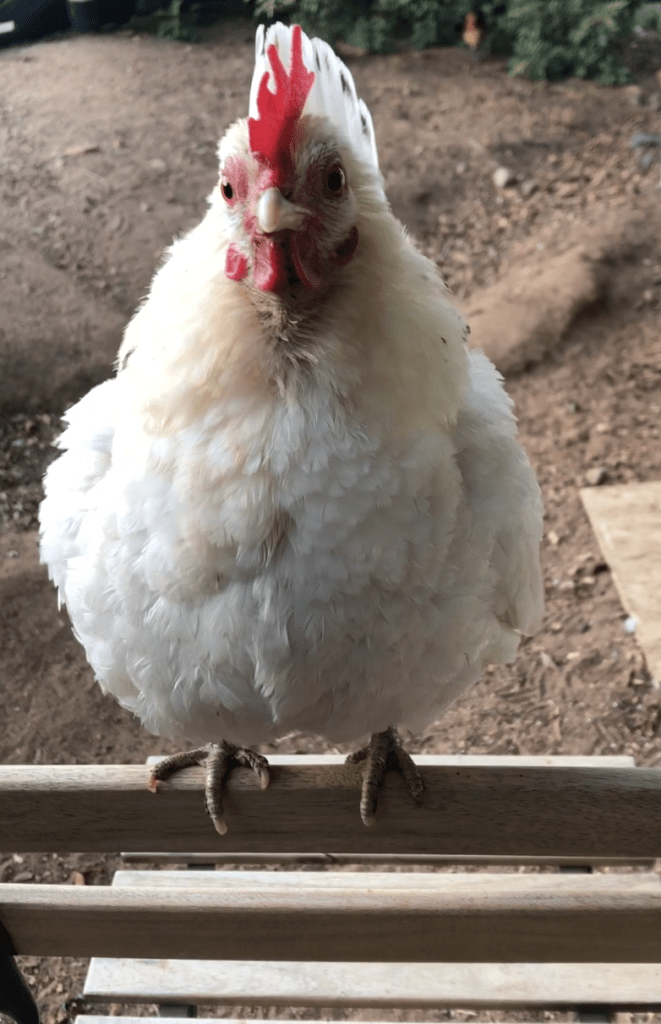
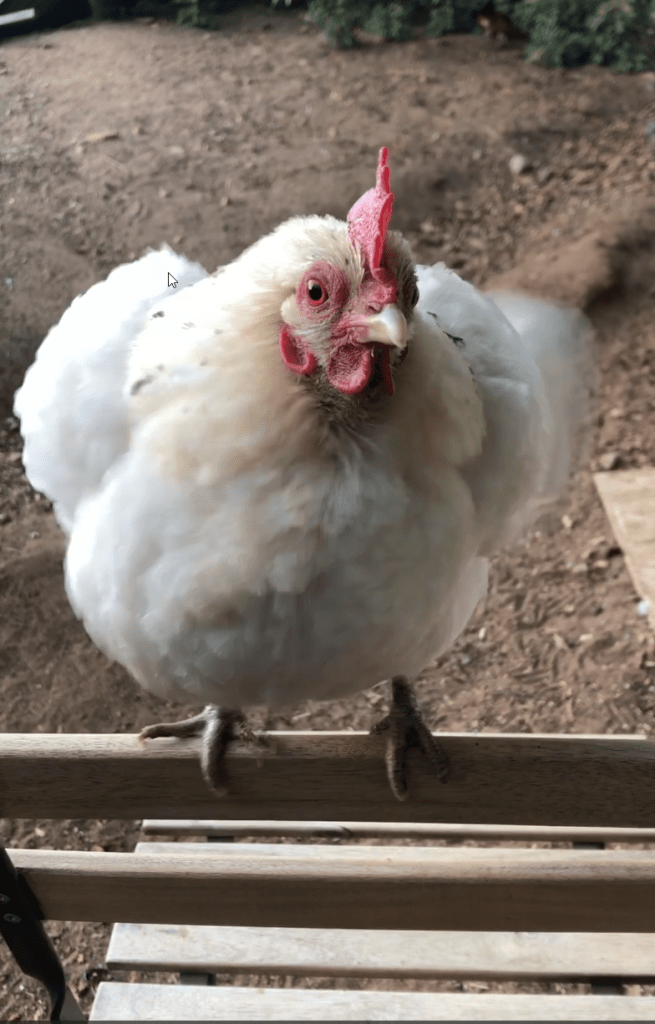
Nyup’s name came from a combination of the words “Nope” and “Yup” which turned out to be a perfect name for her because she is full of contradictions. She always manages to sound grumpy, pretends to not like attention and being held, but settles into your arms and hands as soon as you pick her up (while still sounding grumpy, of course). I need to show you what I mean by her attitude, a single photo won’t do it justice:
But despite her “aggression” she was for awhile the lowest on the pecking order (we’ll meet the other flock members in future posts). This is because Nyup is really more of a lover than a fighter after you get to know her (for anime fans, you might know this as “tsundere”). Suffice to say she was all squawk and no peck.
Here’s a couple “Nyup” moments for you that further show her onion layers of contradiction:
Nyup jumping onto my hand to be held despite her grumbling about it (you jumped on me! I didn’t even pick you up, miss!):
Nyup being incredibly broody. For those who don’t know, broody is when a hen becomes very determined to hatch an egg and be a mama hen, hormones are flooding her body to be more protective than normal. For Nyup, she’s probably trying to hatch an egg for about a quarter of the year. Nyup is by far the the broodiest of the flock, which adds to her grumps:
This would be her mugshotThis is her inviting you to a fight she knows she won’t win
But because of her broody tendencies she’s also the best mom of the flock. She even adopts other chicks that are abandoned. This is a really cool, specific trait that varies by each individual chicken. There are lots of chickens that only want to raise their own, and then there are some chickens like Nyup, who thinks every baby is her baby and she will adopt any and all who need her. You won’t know if your hen has this trait until she starts raising chicks. This was really cool to discover about her when our other hen, Princess Lay-a, turned out to be a terrible mother who constantly abandoned her chicks. Nyup literally took Princess Lay-a’s chicks under her wing and kept them warm. She’s also a great co-parent.
But! If Nyup is a hen, who lays eggs, and is a great mama, how come she can crow like a rooster? I’m glad you asked. While uncommon, it’s not unheard of for a older, more dominant hens to take on rooster-like traits and roles in a roosterless flock. This includes crowing like a rooster to assert their spot in the pecking order, and flapping their wings before crowing to spread the testosterone in their body, etc. But what is especially interesting about Nyup crowing is, like mentioned before, she used to be lowest on the pecking older for so long, and also because she wasn’t our only hen to do it.
Hei Hei, our oldest hen, and by far our most dominant hen since I started keeping chickens (I’ll have a post about her later), also crows. She was actually the first hen in the flock to do it, but she only crowed in the morning, around the time the other roosters in the neighborhood started crowing. I think it’s important to mention that for most of both these hens’ lives, there was a rooster in the flock. First there was Cluck Norris (who’s memorialized as the animated white rooster gif on my site), who gave his life valiantly in protection of our flock against a coyote, and then there was Rooster (named after the Top Gun movie’s Rooster) who was rehomed after he outgrew some of smallest girls, and then there was a young, feral rooster that came by on occasion noticing that the girls were rooster-less who eventually gave up after several visits.
It must have been a few months that went by with no rooster when Hei Hei finally decided she would take on the rooster role. This was likely further triggered by the addition of two more pullets (young hens that are yet to produce eggs) to the flock, the first time hens were introduced without a rooster. Usually a rooster would chase new hens around a bit, and do some drag-wing courtship dances to assert dominance, but this time there was no rooster around. Other ways chickens show dominance is dropping their shoulder/wing, doing some pecking on another chicken’s head, or sometimes even clawing an offending hen with their toes. But I guess these usuals weren’t enough, so Hei Hei decided to crow, and continue to do so. It was pretty cool.
Nyup started crowing shortly after she did, maybe a couple days after, but specifically only in the late afternoons. It was almost like they were doing shift-changes. Hei Hei crows at sunrise, Nyup crows at dusk. An interesting bit of co-flock leading.
Chicken pecking order is really complicated. Generally you can tell which is the most dominant hen from the get-go, with some various telltale signs (other hens usually follow their lead). You can also generally tell who is the lowest on the pecking order (the one gives way for food the most, the one who is picked on most often, etc.). But it starts getting complicated in the middle. You’ll have hen A running away from hen B, but hen B is picked on more often by the more dominant hens. It’s just… tangled. But all the hens in the flock seems to understand what the pecking order is innately.
Nyup was usually the lower-end of the pecking order (she would run away most often even if a hen wasn’t actively going for her), but you can tell she wanted to be a more dominant hen all her life. She would try to stand up to the more dominant hens and then almost immediately give way (like she was testing the waters– “I’m stronger than you! Haha, wait, I was just kidding”). With every new addition to the flock, however, is an upset to the pecking order and a new hierarchy needs to be established. With the two new pullets Nyup saw an opportunity, and started crowing, and Hei Hei, our dominant, chill hen, was cool with it. What’s further interesting though is that though Nyup crows like Hei Hei, Nyup is arguably still squarely in the middle of the pecking order. Hen Griffey Jr. and Princess Lay-a (we’ll have a post on them later, too), is higher on the pecking order than Nyup still, but both don’t crow. Chickens are so interesting!
Anyway, if you enjoyed this bit of Nyup fun facts and read this far, here are a few more pictures of Nyup growing up. Enjoy!:
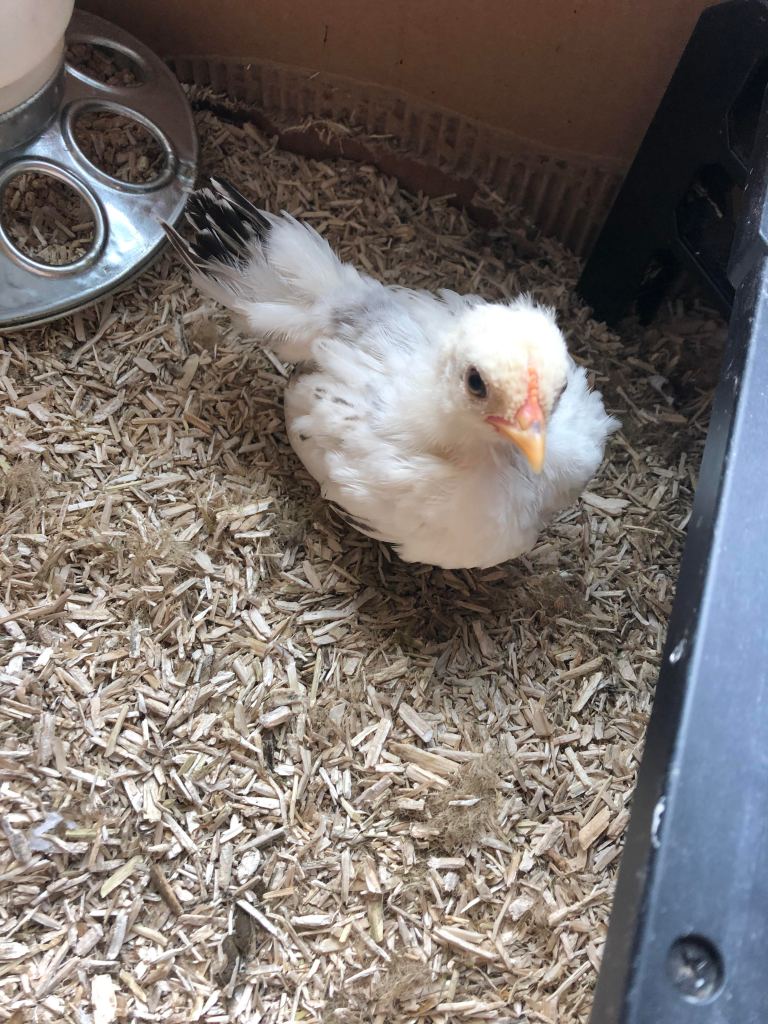
Nyup was always cute.
So chic(k)! At just a few days old, she was looking like the poster chick of a Marshmallow Peep ad
She also always had a bit of an attitude:
Nyup, a few weeks old, judging me, like she would throughout her life.
But her cuteness would manifest into becoming our prettiest hen in the flock:
Thanks for reading, and I hope you enjoyed Nyup’s story. =)





 Melody Sumaoang Plan